Essential Oil
Indonesian Essential Oils
The Origins of Aromatherapy
Steam Distillation
Product Portfolio
Nilam
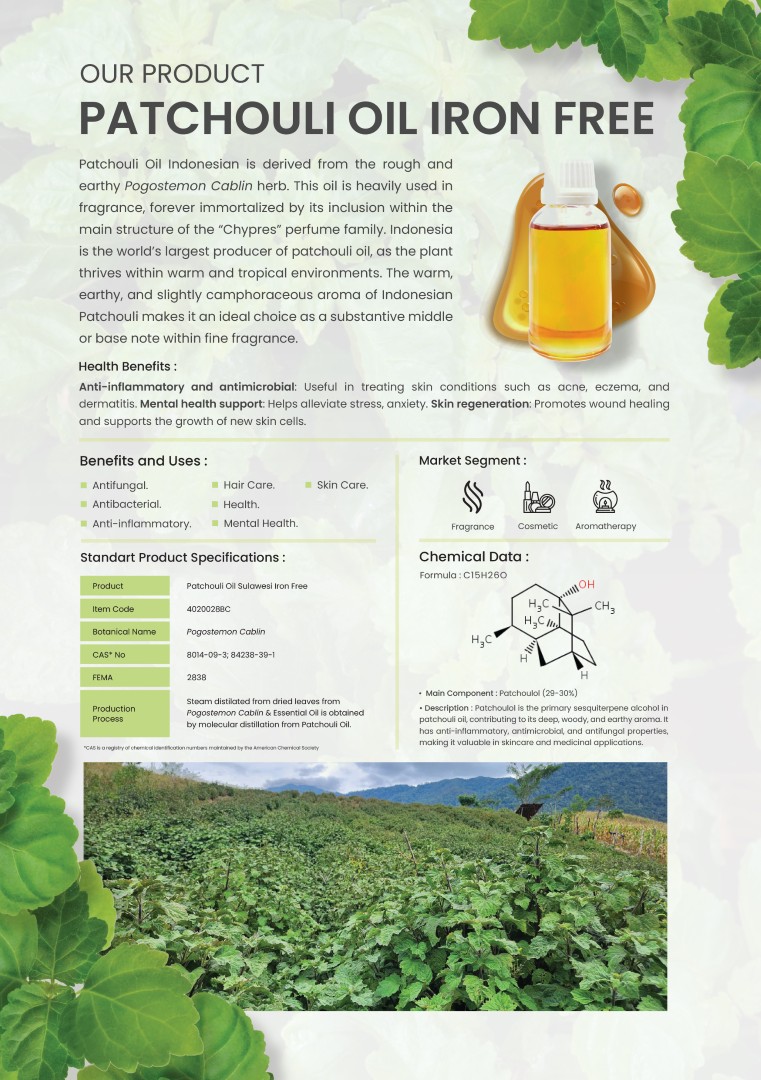
Patchouli Oil Iron Free
Patchouli Oil Iron Free is a variant of Indonesian patchouli oil from Pogostemon cablin, which the source material describes as coming from plants that thrive in Indonesia’s tropical environment. The poster highlights its warm, earthy, and slightly camphoraceous aroma, positioning it as a middle or base note for fine fragrance. The source material also lists uses in fragrance as well as hair care and skin care, with Patchoulol as the main component at around 29–30%. The chemical structure diagram and specification information are shown on the product poster.
BOTANICAL NAME Pogostemon cablin
FEMA NO. 2838
CAS NO. 8014-09-3; 84238-39-1
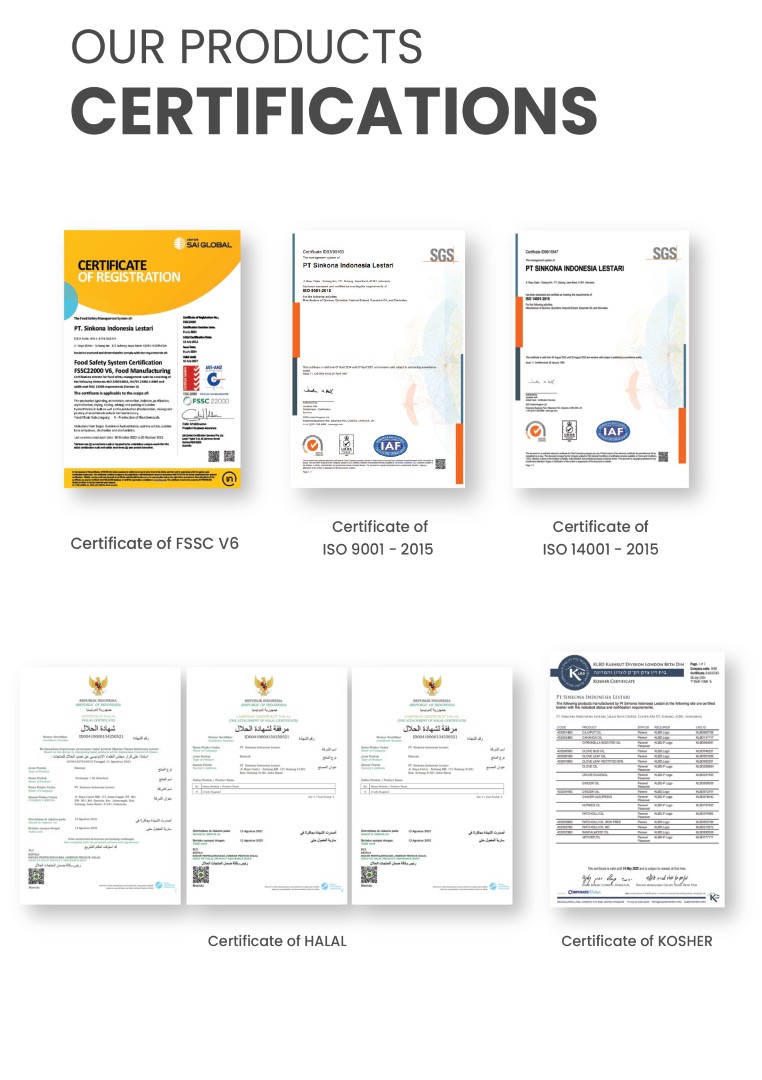
CERTIFICATIONS SHOWN IN SOURCE
Halal · Kosher · FSSC · ISO 9001 · ISO 14001
Nilam
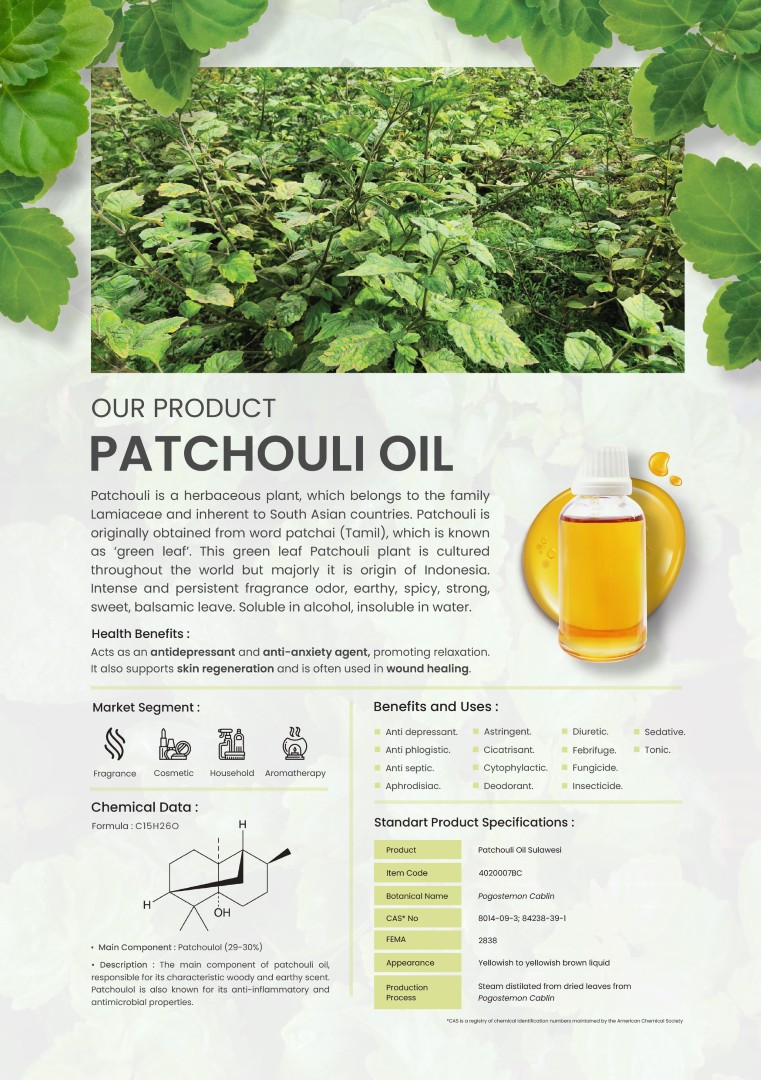
Patchouli Oil
BOTANICAL NAME Pogostemon cablin
PART USED Leaves and Stems
FEMA NO. 2838
CAS NO. 8014-09-3; 84238-39-1
Cengkeh
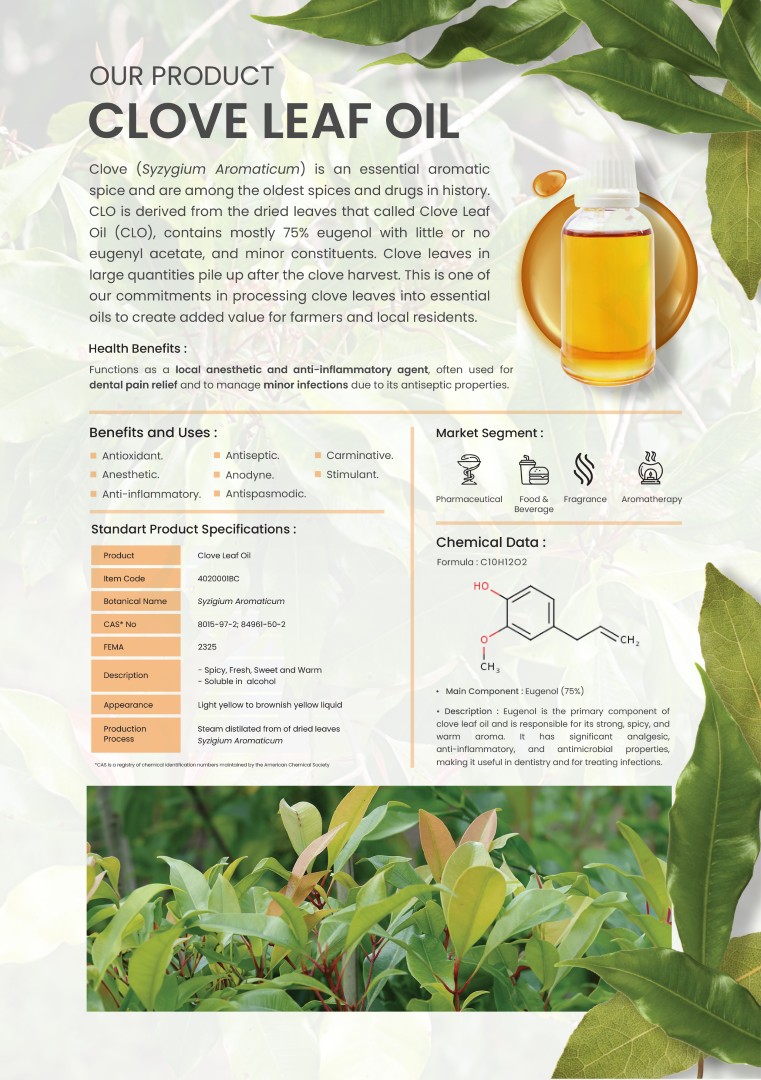
Clove Leaf Oil
Clove leaf oil is derived from the leaves of Syzygium aromaticum.
BOTANICAL NAME
Syzygium aromaticum
PART USED
—
FEMA NO.
2325
CAS NO.
8000-34-8; 84961-50-2
CERTIFICATIONS SHOWN IN SOURCE
Halal · Kosher · FSSC · ISO 9001 · ISO 14001
Cengkeh – Rectified
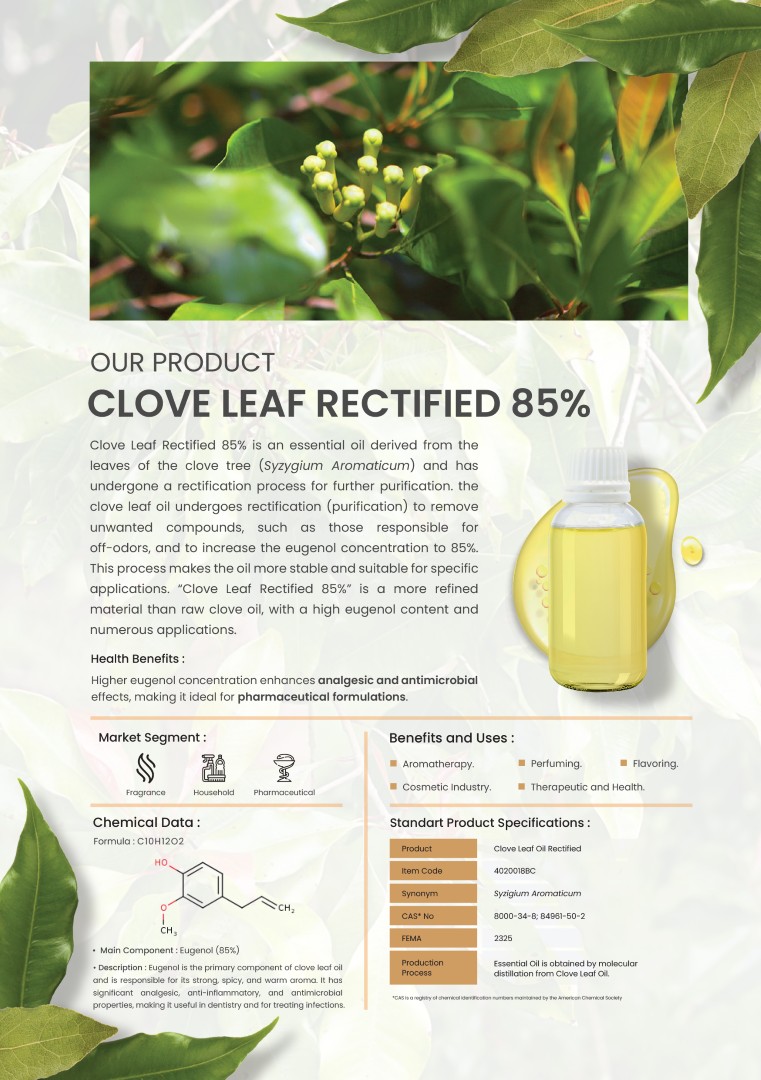
Clove Leaf Rectified 85%
Clove Leaf Rectified 85% is an essential oil from the leaves of the clove tree (Syzygium aromaticum) that has undergone rectification for further purification. The source material explains that this process is intended to reduce unwanted compounds, including those that can cause off-odors, while increasing the eugenol concentration to 85%. The product is positioned as a more refined material than raw clove oil. The poster shows the formula C10H12O2, the main component Eugenol (85%), the molecular structure of eugenol, and uses in fragrance, household, pharmaceutical, aromatherapy, perfuming, flavoring, the cosmetic industry, and therapeutic/health applications.
BOTANICAL NAME
Syzygium aromaticum
PART USED
—
FEMA NO.
2325
CAS NO.
8000-34-8; 84961-50-2
CERTIFICATIONS SHOWN IN SOURCE
Halal · Kosher · FSSC · ISO 9001 · ISO 14001
Sereh Wangi
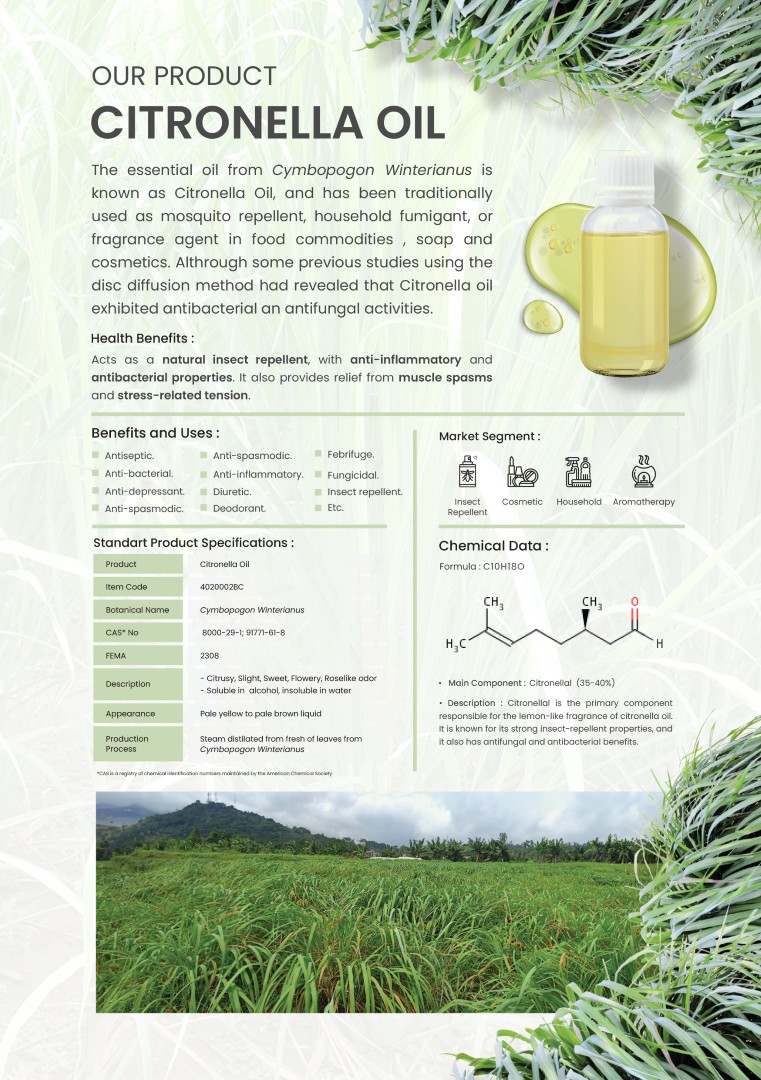
Citronella Oil
Citronella Oil is derived from Cymbopogon winterianus and, according to the source material, has traditionally been used as a mosquito repellent, household fumigant, and fragrance agent in food commodities, soap, and cosmetics. The poster also lists the formula C10H18O, Citronellal as the primary component, its strong insect-repellent character, and uses in insect repellents, cosmetics, household products, and aromatherapy. Chemical data, the molecular structure, CAS 8000-29-1 / 91771-61-8, and FEMA 2308 are shown on the poster.
BOTANICAL NAME
Cymbopogon winterianus
PART USED
Leaves and Stems
FEMA NO.
2308
CAS NO.
8000-29-1; 91771-61-8
CERTIFICATIONS SHOWN IN SOURCE
Halal · Kosher · FSSC · ISO 9001 · ISO 14001
Jahe Merah
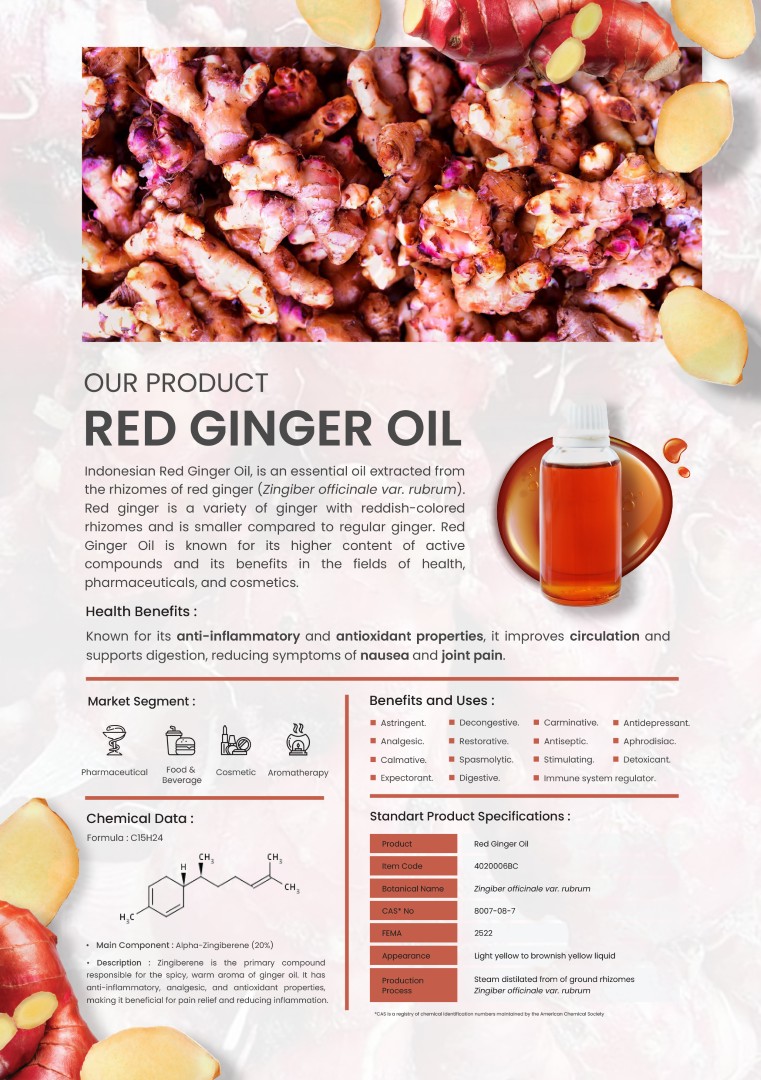
Red Ginger Oil
Indonesian Red Ginger Oil is extracted from the rhizomes of Zingiber officinale var. rubrum. The source material explains that red ginger has reddish rhizomes that set it apart from common ginger, and places its oil in the pharmaceutical, food, cosmetic, and aromatherapy fields. The poster lists various benefits & uses such as analgesic, digestive, carminative, antiseptic, stimulating, and others, along with the formula C15H24O, steam distillation from ground rhizomes, and chemical structure information. These usage claims come from the source material and must be aligned with the regulations of the destination market.
BOTANICAL NAME
Zingiber officinale var. rubrum
PART USED
Rhizomes
FEMA NO.
2522
CAS NO.
8007-08-7
CERTIFICATIONS SHOWN IN SOURCE
Halal · Kosher · FSSC · ISO 9001 · ISO 14001
Pala
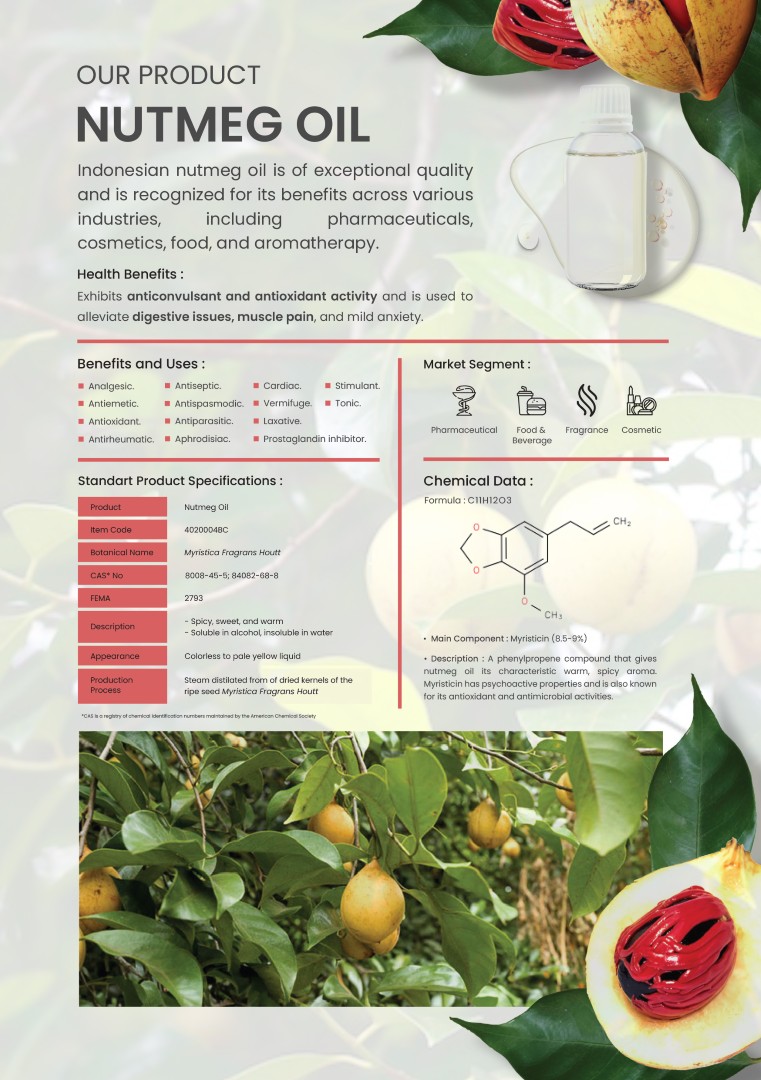
Nutmeg Oil
Indonesian Nutmeg Oil is obtained from the seeds of Myristica fragrans Houtt. and, in the source material, is positioned for various industries including pharmaceutical, cosmetic, food, and aromatherapy. The poster lists its warm and spicy aroma and the formula C11H12O3, with Myristicin as the main component at around 8.5–9% as printed on the poster; the molecular structure and a description of the phenylpropene compound that gives nutmeg its characteristic aroma are also shown. The catalog specification lists FEMA 2793 and CAS 8016-98-4 / 84238-29-9.
BOTANICAL NAME
Myristica fragrans Houtt.
PART USED
Seeds
FEMA NO.
2793
CAS NO.
8016-98-4; 84238-29-9
CERTIFICATIONS SHOWN IN SOURCE
Halal · Kosher · FSSC · ISO 9001 · ISO 14001
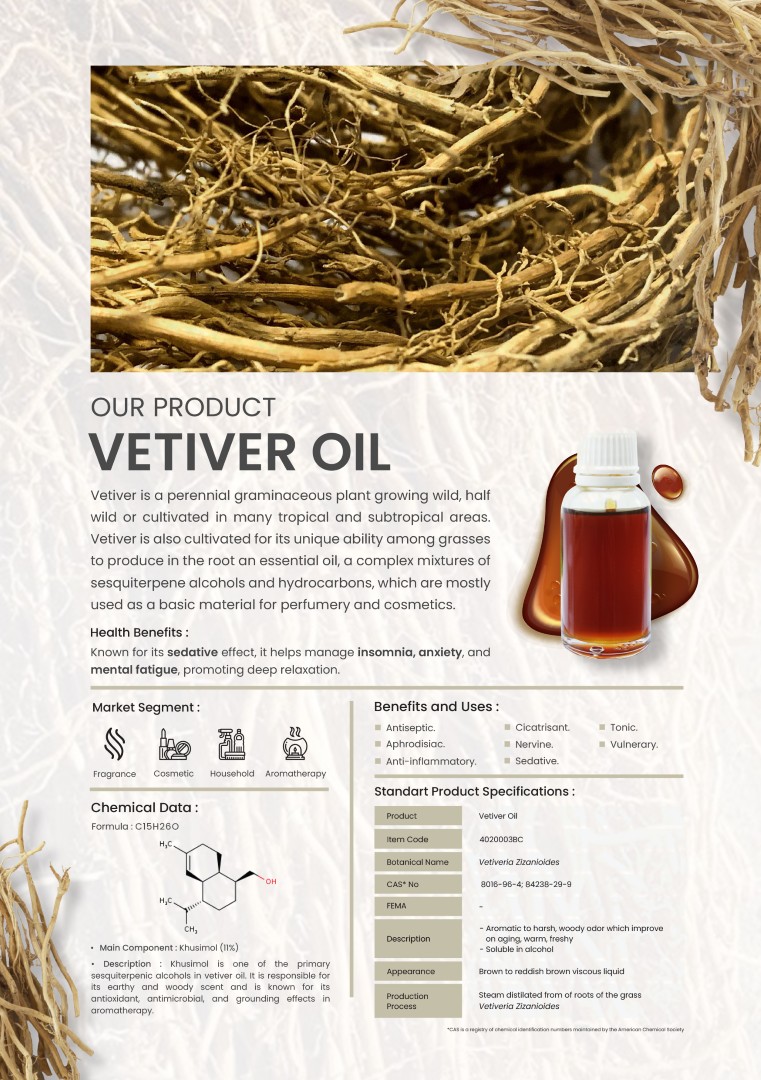
Akar Wangi
Vetiver Oil
Vetiver Oil comes from the vetiver plant, Vetiveria zizanioides, which yields a complex essential oil from its roots. The source material explains that this oil is rich in a mixture of sesquiterpene alcohols and hydrocarbons and is widely used as a base material in perfumery and cosmetics. The poster lists the formula C18H26O, the main component Khusimol, and its earthy and woody character. Its production process is shown as steam distillation from the roots. The chemical structure, CAS data 8016-96-4 / 84238-29-9, and application information are also shown on the poster.
BOTANICAL NAME
Vetiveria zizanioides
PART USED
Roots
FEMA NO.
—
CAS NO.
8016-96-4; 84238-29-9
CERTIFICATIONS SHOWN IN SOURCE
Halal · Kosher · FSSC · ISO 9001 · ISO 14001
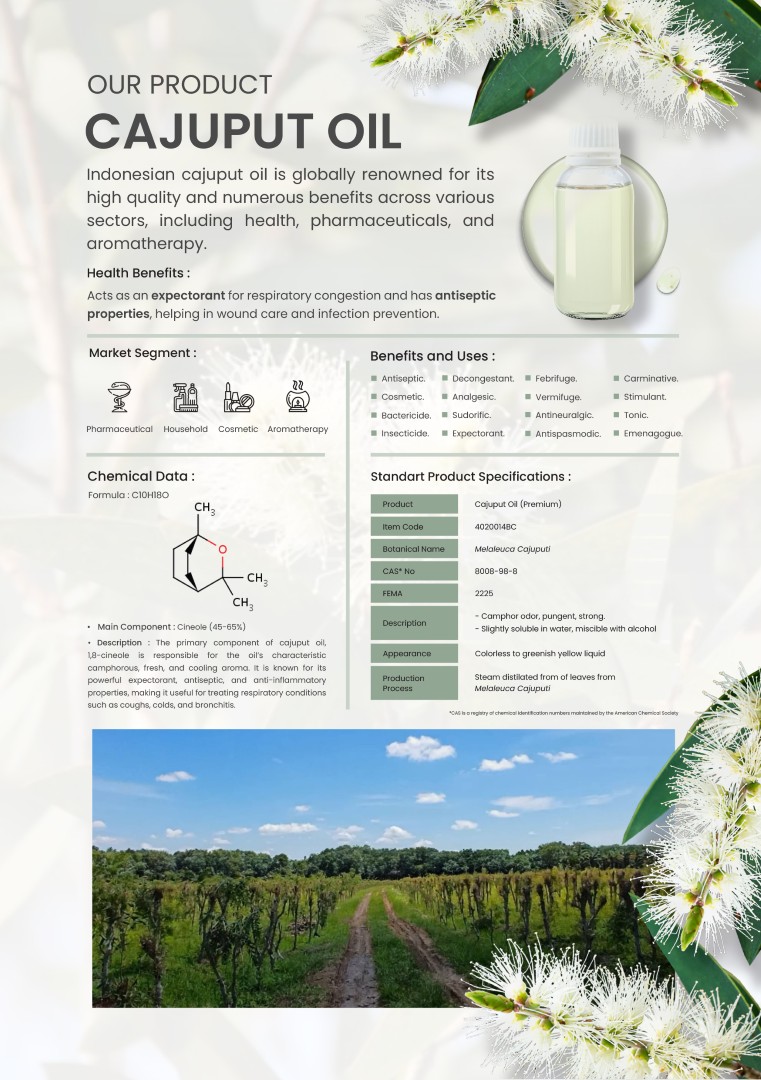
Kayu Putih
Cajuput Oil
Indonesian Cajuput Oil comes from the leaves and twigs of Melaleuca cajuputi and, in the source material, is positioned for health, pharmaceutical, aromatherapy, household, cosmetic, and insecticide applications. The poster shows its pungent and strong aroma, a clear to pale yellow color, and the main component 1,8-Cineole at around 45–85%, the compound that gives cajuput oil its distinctive character. The chemical structure, CAS 8008-98-8, FEMA 2225, and solubility information are also shown on the poster.
BOTANICAL NAME
Melaleuca cajuputi
PART USED
Leaves and Twigs
FEMA NO.
2225
CAS NO.
8008-98-8
CERTIFICATIONS SHOWN IN SOURCE
Halal · Kosher · FSSC · ISO 9001 · ISO 14001
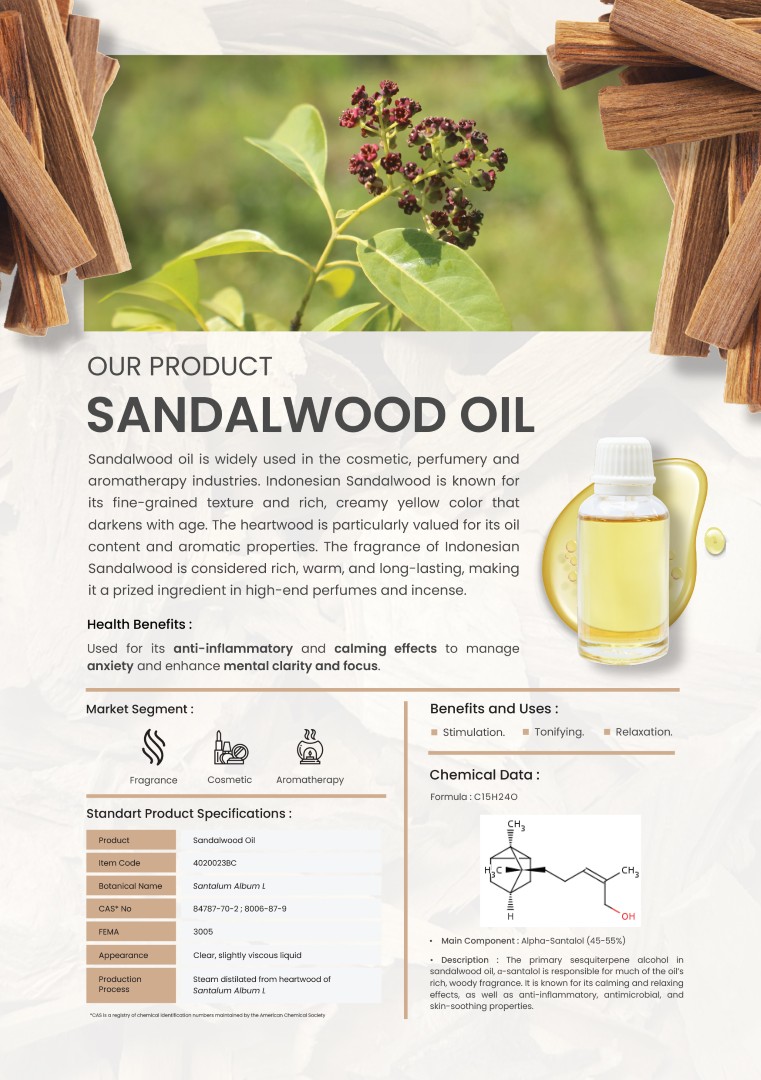
Cendana
Sandalwood Oil
Sandalwood Oil comes from the heartwood of Santalum album L. and, according to the source material, is widely used in cosmetics, perfumery, and aromatherapy. The poster describes Indonesian sandalwood as rich, warm, creamy-yellow, and long-lasting, making it valuable for fine fragrance and incense. The chemical data lists the formula C15H24O and the main component Alpha-Santalol at around 48–88%, as printed on the poster. The molecular structure, CAS 84787-70-2 / 8006-87-9, FEMA 3005, and application information for fragrance, cosmetics, and aromatherapy are shown in the source material.
BOTANICAL NAME
Santalum album L.
PART USED
Heartwood
FEMA NO.
3005
CAS NO.
84787-70-2; 8006-87-9
CERTIFICATIONS SHOWN IN SOURCE
Halal · Kosher · FSSC · ISO 9001 · ISO 14001
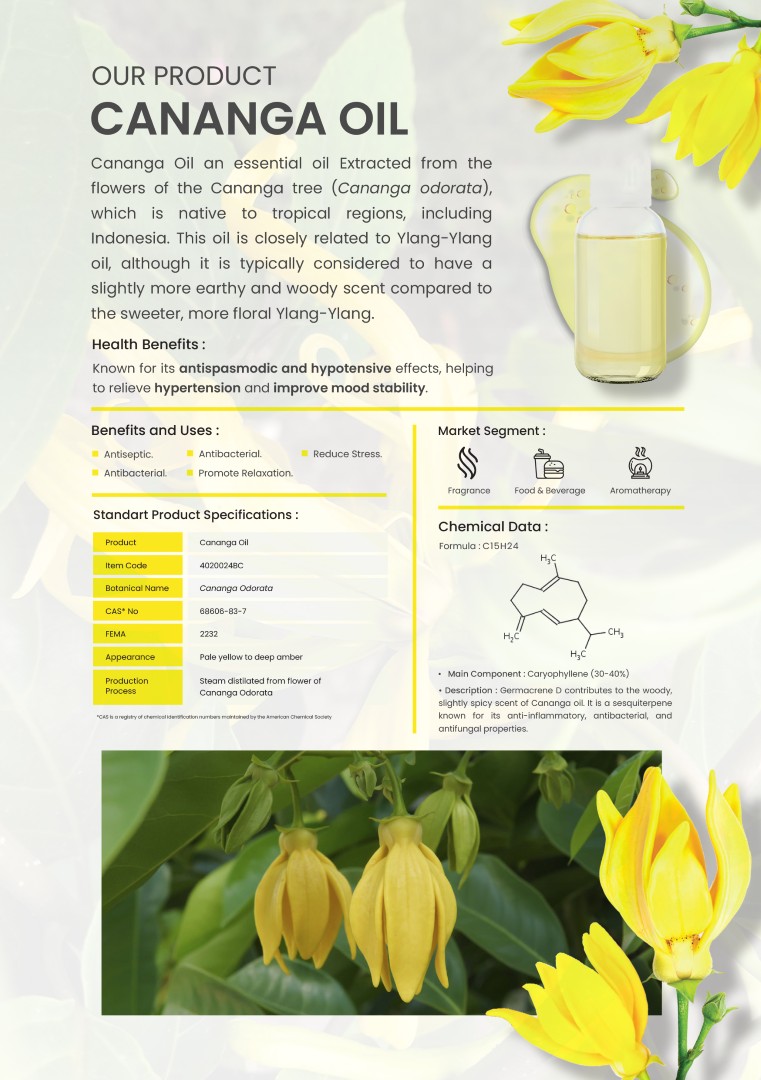
Cananga
Cananga Oil
Cananga Oil is an essential oil extracted from the flowers of Cananga odorata, a plant native to tropical regions including Indonesia. The poster compares its aroma with ylang-ylang: cananga is described as slightly more earthy and woody, while retaining a floral character. The source material places it in fragrance, food & beverage, and aromatherapy. Chemical data, the formula C15H24O, steam distillation from the flowers, and the molecular structure and specifications FEMA 2232 / CAS 68606-83-7 are shown on the poster.
BOTANICAL NAME
Cananga odorata
PART USED
Flower Bud
FEMA NO.
2232
CAS NO.
68606-83-7
CERTIFICATIONS SHOWN IN SOURCE
Halal · Kosher · FSSC · ISO 9001 · ISO 14001
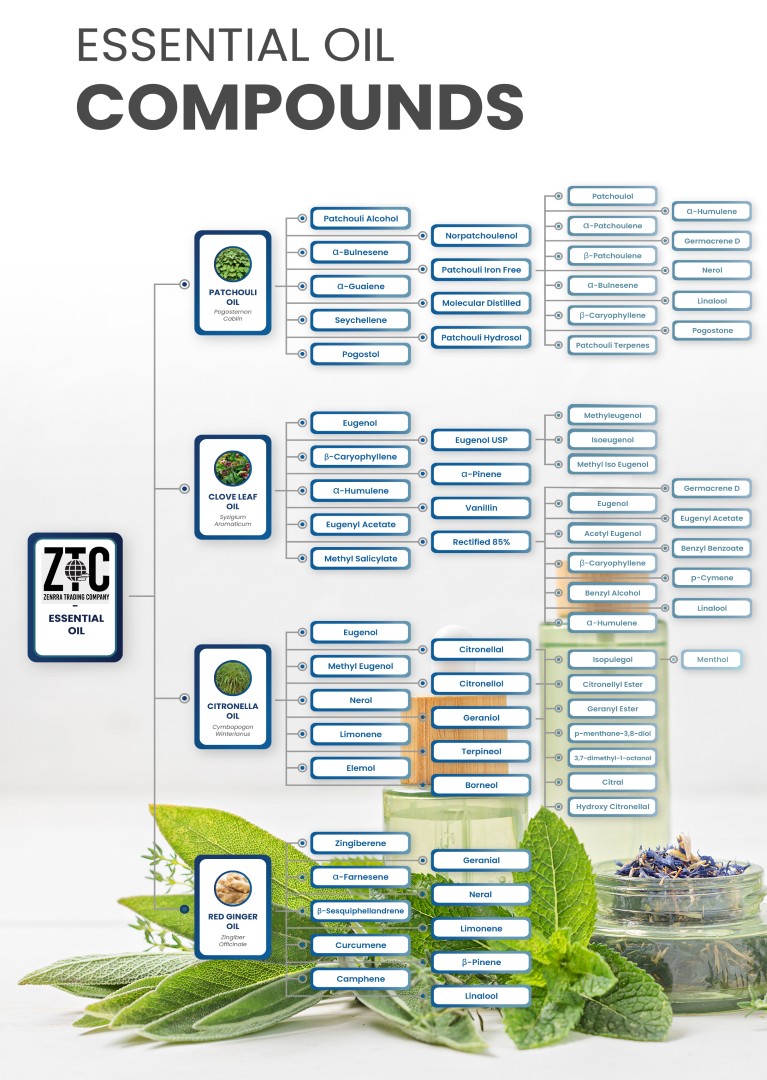
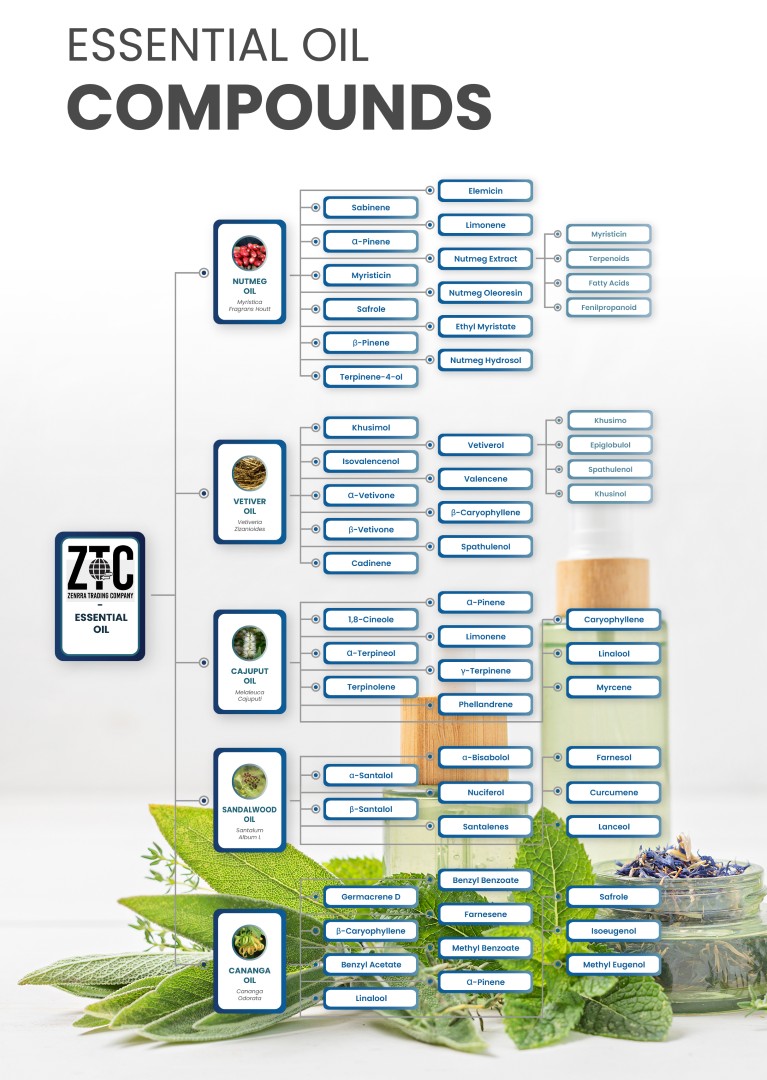
Essential Oil Compounds
Documentation and Certification
FSSC V6, ISO 9001:2015, ISO 14001:2015, Halal, and Kosher as part of the portfolio documentation.